
Tuesday’s study session included two long presentations on the 2027-2028 budget. One on the process and calendar. One on long-term fiscal sustainability. Staff asked council for thoughts on revenue options. The conversation will continue over the next several meetings.
What’s happening
The city’s budget has a structural problem. Ongoing expenses grow faster than ongoing revenues (mostly property tax, which is capped at 1% per year). The prior council accepted a three-phase plan from a resident taskforce: first, the city would reduce costs. Second, council would adopt a utility tax. Third, voters would approve something larger, likely a Metropolitan Park District.
The first two phases are done. Staff reports cost reductions of $8.9 million. The utility tax, which took effect January 1, is expected to generate about $11 million a year. Those steps buy us through 2028. After that, the gap opens up again.
The question in front of council is what to do about phase three. Or whether phase three should look different than the plan drawn up in 2023.
Start with the spending side
Staff asked what kinds of revenue council would support. I gave them a list of ideas I’m willing to consider. But I told them I’m not ready to support any of it yet.
Before I ask residents for more in taxes, I want to be absolutely certain of what we’re spending it on. That requires a real line-by-line review of the budget. According to staff, that level of visibility does not currently exist because of the city’s budgeting software. They are in the process of changing that software, and we should have better visibility this year. Program-based budgeting, which staff is already rolling out, will help us see the true cost of each program and what it would look like to adjust the elvel of service. I support that approach.
But, I think we need to go a step further. I want this budget to be a zero-based budget. This essentially means each department starts from scratch instead of copy+pasting the previous budget, adding inflation, and adjusting around the edges.
I also want more detail on the $8.9 million in cost reductions already reported as part of Phase 1. Sammamish has a history of over-estimating expenses and under-estimating revenue. Some portion of the $8.9 million may reflect real reductions. Some portion may reflect removing budget bloat that was never going to be spent. I don’t have an answer yet. I’ve asked staff to provide one.
Sammamish also has a high vacancy rate right now. Before we fill every open position, I want us to ask whether each one is still the right position. Some probably are. Some probably aren’t. We should decide on purpose, not by default.
Show residents the work
The people closest to the work often see efficiencies and improvements management doesn’t. Well-run organizations tap into that.
The city may already be doing this internally. If it is, those ideas should be surfaced to council. Residents deserve to see that real work is happening to use their money well. Whether that’s an anonymous channel for staff to flag ideas, a recognition program, or a simple commitment to bring staff-sourced suggestions into the budget conversation, this work should be visible to the people paying the bill.
Testing the premise
The fiscal sustainability work rests on one load-bearing assumption: that residents want current service levels maintained. That was the explicit guiding principle for the 2023 taskforce, and it has shaped every recommendation since.
I’m not sure that assumption was ever tested. Of course residents want a high level of service. The real question is at what cost. That’s the tradeoff we haven’t put in front of people.
The utility tax conversation surfaced real frustration about rising costs. A lot of residents wrote in opposed. Others told us they were stretched thin. Before we ask residents to pay another tax, we owe them a clear conversation about what’s essential, what could be done differently, and what they’re willing to trade.
The math we can’t avoid
Here’s the truth about the revenue problem: we can’t cut our way to fiscal sustainability. The city’s revenue sources are not keeping up with inflation. Property tax is capped at 1% growth per year. Most other sources are projected to grow around 2% per year. Expenditures are projected to grow over 4.5% per year.
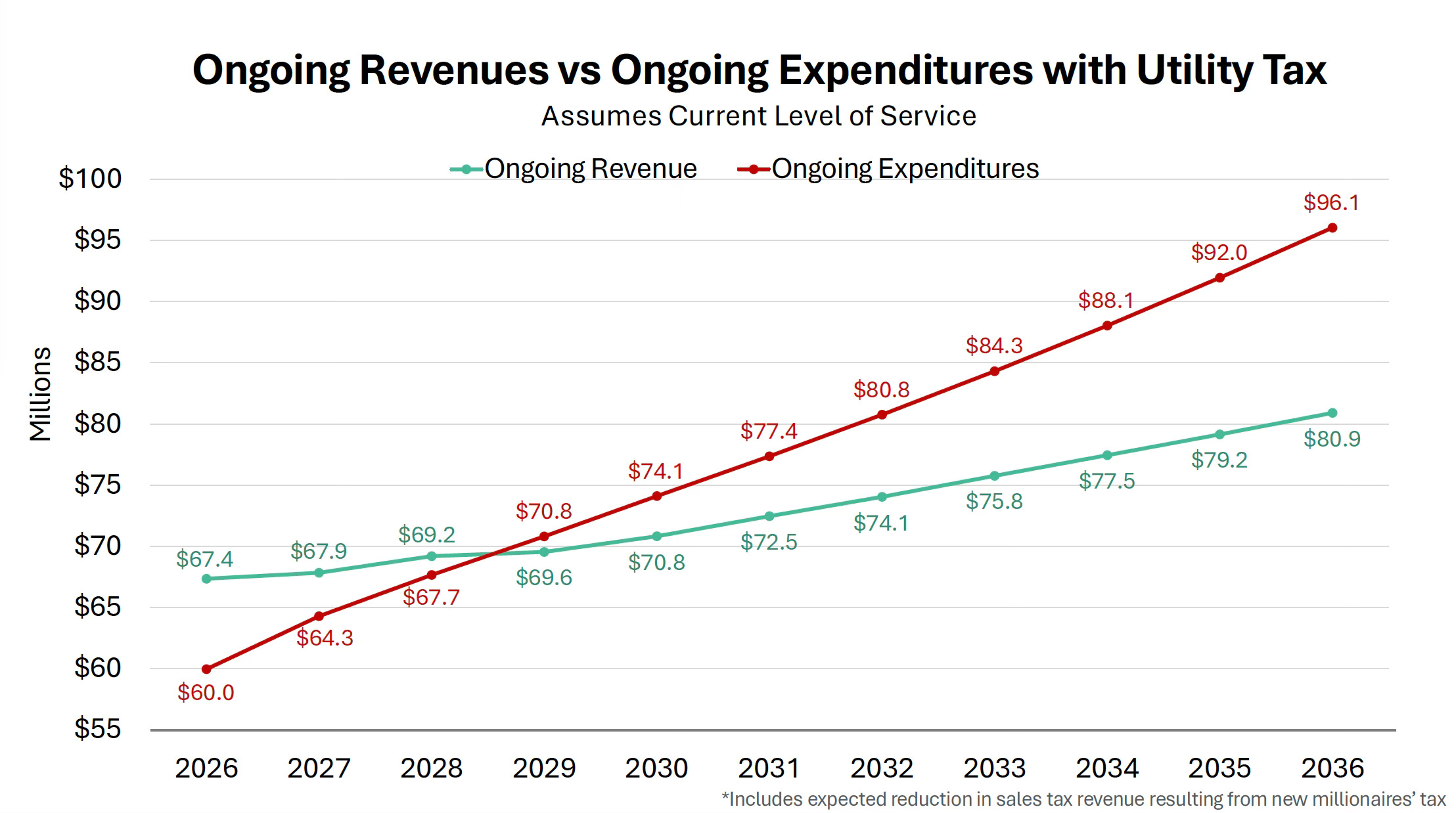
Some mix of cuts and new revenue is the likely outcome. The question is how we get there, and whether we do it transparently.
Context matters. Of the 10.3% sales tax you pay in Sammamish, the city’s share is 0.86%. Of your property tax bill, the city receives roughly 14 percent. The rest goes to the state, the county, schools, sound transit, library, and other districts. The city is also expected to see a reduction in sales tax revenue due to the new millionares’ tax.
That’s not an argument for ignoring tax burden. It’s the opposite. When residents tell me their taxes are too high, the city controls a small slice of that bill. Making that slice count is the whole job.
My approach on revenue
I did share a short list of revenue ideas with staff. I’ll write more about the specifics in a follow-up post. For now, my approach is this:
I’m skeptical of broad-based tax increases that go into the general fund with no clear purpose. If the city asks for a broad-based increase, it should be tied to a specific use, like public safety or roads, so residents know exactly what they’re paying for and can hold the city to it. I’m more open to targeted revenue ideas that draw from new sources or tie revenue to specific purposes.
But, in my view, none of those ideas should move before the spending-side work is done.
What happens next
Fiscal sustainability will be back on council agendas regularly. Staff is looking for direction by early summer so the City Manager can build the draft budget around it. Between now and then, I want us to do the spending-side work thoroughly, give residents real context on what their tax dollars pay for, and have a clear conversation about tradeoffs.
If we end up at a revenue conversation, it should come after we’ve earned the ask.